A Brief Discussion on ATF and TFF Tangential Flow Technology
- Share
- Issue Time
- Feb 27,2026
Summary
The perfusion culture process often achieves higher live cell density and viability, especially for unstable products, where perfusion culture demonstrates unique advantages.
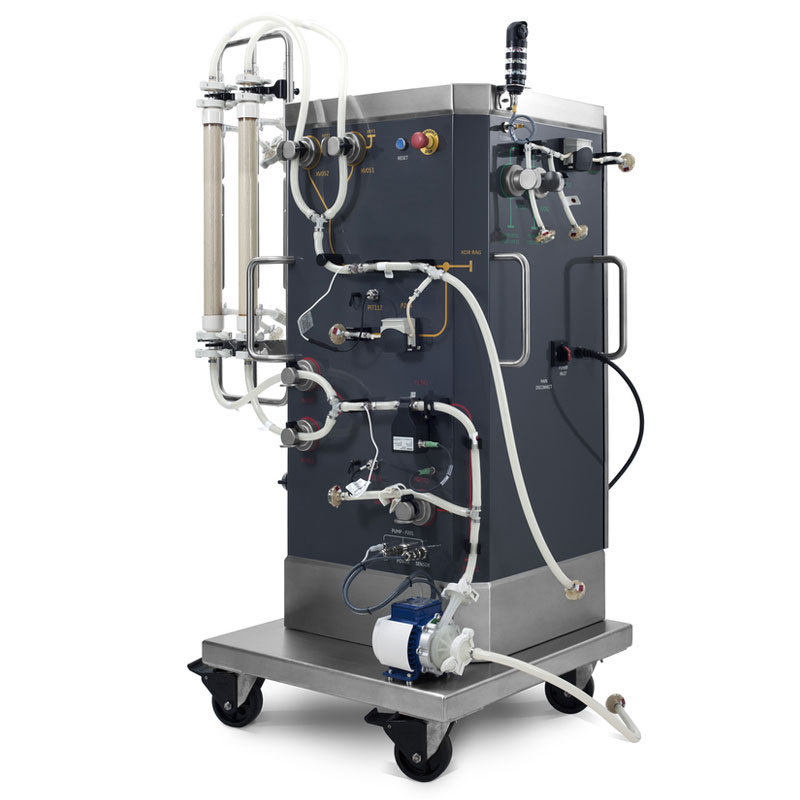

The continuous market growth drives the continuous improvement of equipment and processes. Although fed-batch processes still occupy an important position in the market, perfusion culture processes are gradually attracting attention.
Compared with traditional batch and fed-batch processes, perfusion culture processes can often achieve higher viable cell density and viability, especially for unstable products, perfusion culture shows unique advantages.
For perfusion culture processes, in addition to bioreactors, cell retention devices are also an essential part. At present, there are many types of cell retention devices, and their principles are usually filtration, ultrasound, gravity sedimentation and centrifugation.
Considering factors such as retention efficiency and scalability, membrane filtration technology has been widely used.
Different from conventional dead-end filtration, membrane filtration used in perfusion culture is usually tangential flow filtration based on hollow fiber columns.
In this filtration method, the circulating feed liquid continuously flows through the membrane column, and the "scouring effect" formed by the liquid washes the entire membrane surface, reducing the risk of membrane pore clogging and membrane fouling, realizing long-term stable membrane filtration, and meeting the demand for long-term stable cell culture in perfusion processes.
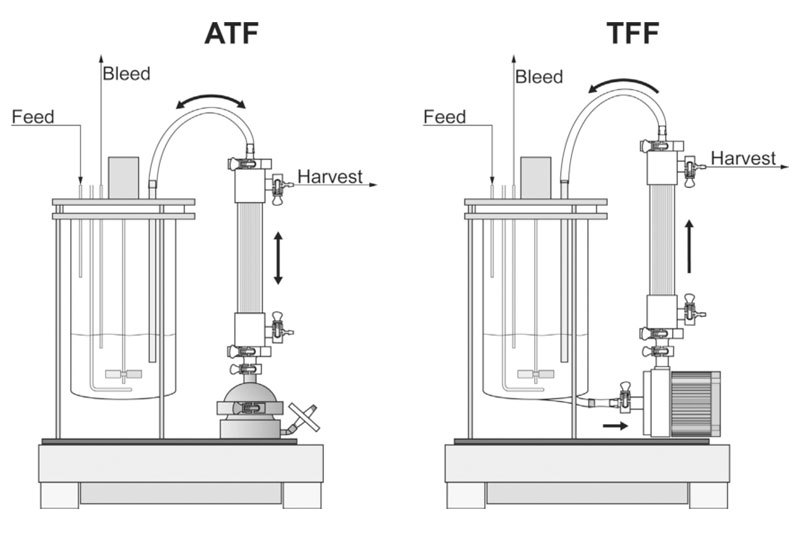
According to the direction of fluid movement and power source, tangential flow filtration can be divided into ATF and TFF. Today, I will introduce these two tangential flow filtration methods. First of all, both ATF and TFF are tangential flow filtration technologies based on hollow fiber columns, and they have many similarities in terms of membrane column selection, use, scale-up, and tangential flow technology.
The differences are as follows: ATF uses an air-driven diaphragm pump as the power source. Through the continuous alternation of air intake and vacuum source, the diaphragm produces up-and-down reciprocating movement, making the cell culture medium run back and forth continuously in the hollow fiber column.
The harvest liquid is harvested through the hollow fiber column membrane, and the cells are retained in the reactor by the membrane column, realizing cell retention and effectively avoiding membrane column clogging.
ATF is characterized by the use of a diaphragm pump for liquid drive. The shear force of this pump is relatively low, avoiding cell damage caused by shear. At the same time, the reciprocating movement is also considered to contribute to the flushing of the membrane column to a certain extent.
However, the system operation of ATF is relatively complex and difficult to understand, and the drive of the air source may lead to insufficient driving force. Especially in the process of high-density cell culture, the culture may not continue due to insufficient driving force.
At the same time, the diaphragm pump also needs to be used with components such as a vacuum source, resulting in increased costs. The price of a set of ATF may even be close to that of the matching reactor.
In addition, due to the power source and design reasons, different culture volumes often require different specifications of ATF to match, or even multiple ATFs used in parallel, which further increases the price.
TFF uses unidirectional flow pumps such as peristaltic pumps and centrifugal pumps for liquid drive. The rotation of the pump makes the cell culture medium move unidirectionally on the hollow fiber column, which also realizes the cleaning of the membrane column.
Like ATF, the harvest liquid is harvested through the hollow fiber membrane column, and the cells are retained in the membrane column and returned to the bioreactor. Previous TFF used peristaltic pumps for liquid drive, which had relatively high shear force and might have adverse effects on long-term cell culture.
However, current TFF suppliers have replaced the power source with low-shear centrifugal pumps to avoid this problem. In addition, the TFF system is simple, the liquid movement mode is intuitive and concise, and users can even build the system themselves for simple process exploration.
Moreover, TFF has a larger driving force and a wider adjustable range of flow rate, which is also conducive to high-density cell culture and the compatibility of the same set of TFF with different sizes of reactors.
Comparison of ATF and TFF data performance: Technical personnel from Bailun Biotech conducted parallel experiments to compare the performance of peristaltic pump TFF and ATF.
The reactor culture volume was 2 L, and CHO cells were cultured to produce mAb; hollow fiber columns with an inner diameter of 1 mm and a pore size of 0.2 μm were used for cell retention, and the shear rate was controlled below 2000 s−1.
The experimental results were: compared with ATF, peristaltic pump TFF had lower cell growth rate, faster decrease in cell viability and higher product retention rate.
Subsequently, the technical personnel of our company studied the particle size distribution in the bioreactor. The results showed that with the progress of perfusion culture, particles with a particle size of 100 nm in the bioreactor of peristaltic pump TFF continued to accumulate. On Day 8, the number of particles was nearly 4.5 times that in the ATF bioreactor.
The decrease in cell viability may be the cause of these differences, because low cell viability can produce more DNA, proteins and other cell components, which may lead to membrane column clogging and subsequent increase in product retention rate.
To understand the relationship between the decrease in cell viability and the number of micro-particles, the technical personnel induced cell apoptosis. Sure enough, with the decrease in cell viability, the number of micro-particles around 100 nm also increased, which explained the micro-particle accumulation in the peristaltic pump TFF reactor.
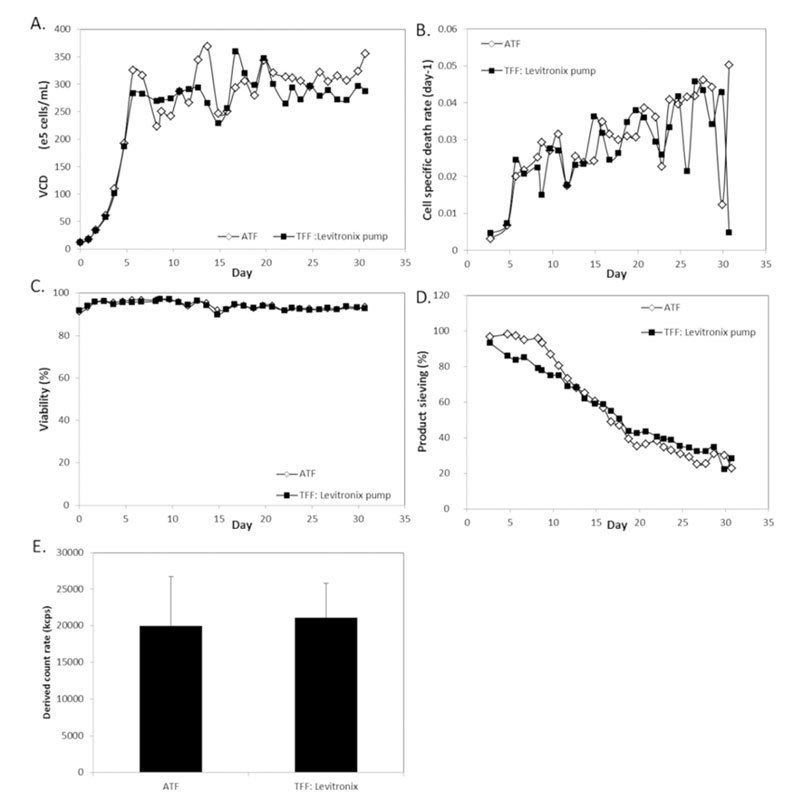
Subsequently, the technical personnel of our company replaced the peristaltic pump with a low-shear centrifugal pump in TFF and conducted parallel experiments with ATF.
Different from using peristaltic pumps, there was no difference in cell growth curve, cell viability and the number of 100 nm micro-particles between centrifugal pump TFF and ATF, and finally similar product recovery rates were achieved.
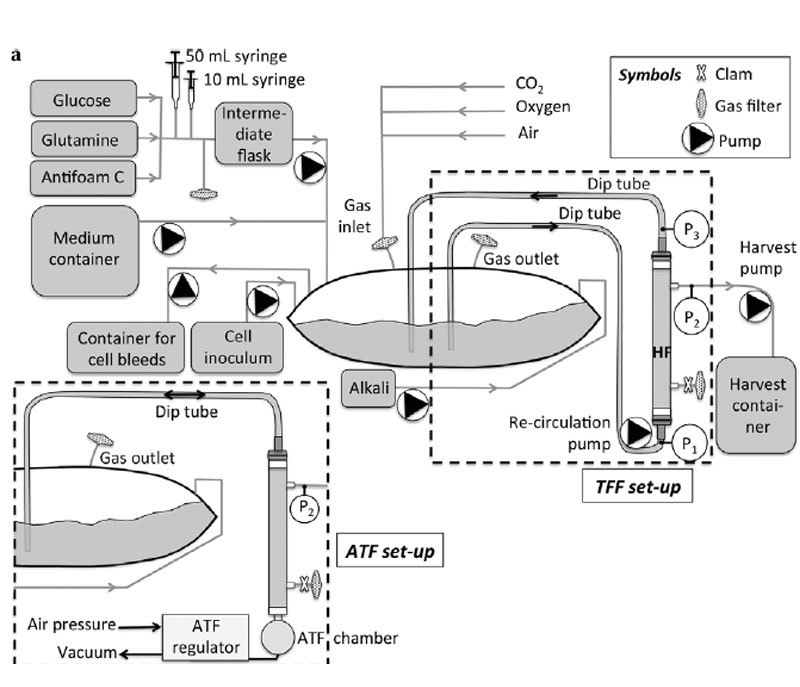
In addition, other technical personnel from Bailun Biotech also conducted a parallel comparison between ATF and TFF. WAVE bioreactors were used to culture CHO cells with a culture volume of 4 L; hollow fiber columns with an inner diameter of 1 mm, a pore size of 0.2 μm and a membrane area of 850 cm2 were used for cell retention.
The results showed that when the cell density was maintained at 20-35×106 cells/ml, ATF and TFF performed consistently in parameters such as cell growth rate, viability and cell diameter. Subsequently, the technical personnel conducted high-density cell culture.
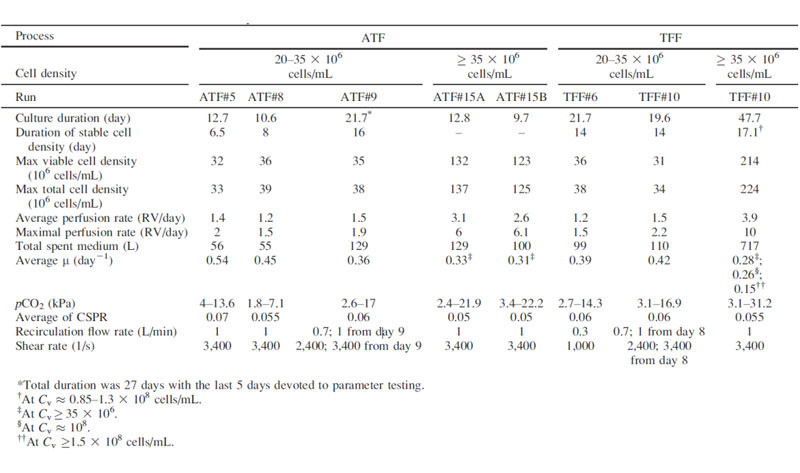
In the ATF experiment, by Day 10, the cell density reached 132×106 cells/ml. At this time, possibly due to the high viscosity of the medium, the power of the diaphragm pump was insufficient to maintain the alternating operation of the medium in the hollow fiber; in the TFF experiment, when the cell density was between 28~105×106 cells/ml, the cell growth was consistent with that of ATF.
Then, the cell density was maintained at 90~130×106 cells/ml for 2 weeks through Cell bleeding, and finally the cell density reached a maximum of 214×106 cells/ml by increasing the perfusion rate, but at this time the cells had stopped growing.
This may be due to the increase in circulating pump pressure caused by the increase in fluid viscosity under high cell density, or pCO2 has reached 31 Kpa, affecting cell growth. In addition, oxygen transfer began to be limited at this time. In both ATF and TFF experiments, the cell viability was maintained above 90%, but with the increase of cell density, the cell growth rate gradually decreased.
Conclusion: In general, both ATF and TFF are tangential flow filtration technologies based on hollow fiber membrane columns. Although each has its own characteristics, many literatures and practical cases have shown that they perform similarly in perfusion culture and are feasible alternatives.
To meet the market demand for perfusion culture, Bailun Biotech has launched an automatic perfusion system. The system is based on tangential flow filtration technology (TFF) and uses a low-shear centrifugal pump for liquid transfer to avoid the impact of shear force on cells.
A single unit can support 50-500 L scale bioreactors, avoiding repeated purchase of equipment during process scale-up and reducing the user's cost of use.
The system integrates multiple peristaltic pumps and sensors, which can realize automatic switching of two hollow fiber columns, automatic switching of medium storage tanks and automatic cell bleeding, ensuring the safety and stability of the culture process.
The control interface of the system can be fully integrated into the controller of the bioreactor. The controller uniformly controls the reactor and the system, as well as records and exports data. It is a truly convenient, concise, highly automated and easy-to-scale perfusion equipment.
At the same time, Bailun Biotech has hollow fiber columns of various specifications with high pore size uniformity and good physical tolerance, which can meet the requirements of various perfusion processes for hollow fibers. Welcome all users to consult.